Cursive vs Italic vs Script — What's the Difference?
Confused by cursive, italic, and script? See side-by-side examples, learn when each term applies, and preview styles in our free font generator.
Search for handwriting styles online and you will see three words used interchangeably: cursive, italic, and script. Font listings mix them. Teachers use one term while designers use another. No wonder people ask whether italic counts as cursive, or whether script means the same thing as both.
This guide defines each term clearly, shows visual examples, and helps you pick the right style for your project.
Cursive vs script vs italic: the one-line answer
Cursive is handwriting whose letters connect in a continuous flow; script is the umbrella term for any flowing, handwritten-style lettering — cursive is one script style among many; and italic is a slanted print style whose letters usually stay unconnected. All three get labelled "handwriting fonts" in font stores, which is exactly why the words blur together — the comparison chart below shows the practical differences side by side.
The 3 Terms Confused Daily
| Term | Core idea | Letters connected? | Typical context |
|---|---|---|---|
| Cursive | Handwriting where strokes link for speed | Usually yes | School writing, notes, signatures |
| Italic | Slanted letterforms, often with a pen angle | Often no | Typography, emphasis, some handwriting systems |
| Script | Any flowing, handwritten-style typeface | Sometimes | Design, branding, invitations, fonts |
The overlap causes confusion: a font named "Script" may look cursive. Italic type in Word is slanted print, not cursive at all. And school "cursive" workbooks may teach styles that designers call "formal script."
Cursive: Connected, Functional Writing
Cursive describes writing (or fonts that mimic it) where letters connect in a continuous flow. The goal is speed and rhythm — your pen stays on the page between most letters.
Characteristics:
- Connected strokes on the baseline
- Loops on ascenders and descenders (l, g, y)
- Developed for everyday writing, not display decoration
- Taught in schools as "joined-up handwriting"
Examples in the wild: Zaner-Bloser school cursive, D'Nealian, everyday personal handwriting, most signature styles.
Try connected styles in the cursive text generator or practice letter forms with the cursive alphabet generator.
For a full learning path, read how to write in cursive.
Italic: Slanted, Often Not Connected
Italic originally referred to a slanted pen angle used in calligraphy — letters lean forward but each letter can be written separately. In typography, "italic" often means any slanted variant of a typeface, even sans-serif fonts that have nothing to do with handwriting.
Characteristics:
- Forward slant (typically 10–15°)
- Letters may not connect
- Used for emphasis in books (like this)
- Italic handwriting systems (e.g., Getty-Dubay Italic) teach slanted separate letters
Key distinction: slanted print in Microsoft Word is "italic" but not cursive. School italic handwriting is slanted but may not join letters — so it is italic without being cursive.
Compare slanted vs connected output in the cursive font generator by switching between casual script and upright fonts.
Script: An Umbrella Term
Script is the broadest term. In typography and design, it means any typeface that resembles handwriting or calligraphy — connected or not, slanted or not, formal or casual.
Characteristics:
- Flowing curves and personal character
- Ranges from casual marker handwriting to formal wedding calligraphy
- Used in logos, invitations, social graphics, and display text
- Not tied to a single school standard
Examples: Dancing Script, Great Vibes, Brush Script, Pacifico — all called "script fonts" but with very different feels.
Formal script styles overlap with calligraphy. Preview those in the cursive calligraphy generator. Casual script styles appear in the handwritten cursive generator.
Visual Comparison Chart
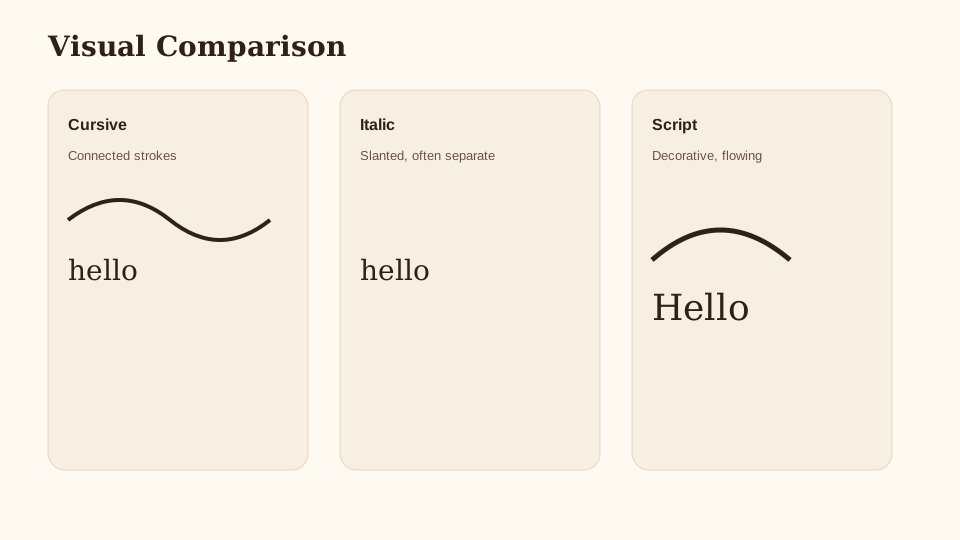
Same word, three treatments:
- Cursive — hello with joined strokes, pen rarely lifts
- Italic — hello slanted forward, letters separate
- Script — Hello with decorative curves, designed for display
The cursive font generator is the fastest way to see this comparison with real fonts — type one word and scroll through connected school cursive, slanted italics, and decorative scripts side by side.
When to Use Which
Choose cursive when you need functional connected writing — classroom practice, signature design, readable personal notes, or worksheet models. Start with the cursive writing generator.
Choose italic when you need slanted emphasis without full connection — italic handwriting curricula, typographic emphasis, or labels that need angle without loops.
Choose script (fonts) when you need visual style for design — wedding invitations, logos, social media graphics, brand names. Use cursive font generator for PNG/SVG export or fancy cursive generator for elegant display styles.
For formal events where script and calligraphy blur together, use the cursive calligraphy generator.
Not sure which you need? If the goal is "make my text look handwritten and pretty" — you probably want a script font. If the goal is "learn to write faster by joining letters" — you want cursive practice.
Frequently Asked Questions
Is italic the same as cursive?
No. Italic means slanted letterforms. Cursive means connected writing. A style can be both (slanted connected cursive), but italic type in word processors is usually neither connected nor handwritten.
Is script the same as cursive?
Script is broader. All cursive fonts are script-style, but not all script fonts are cursive — many script typefaces have disconnected letters designed for display.
Which term should I search for a font?
Search script font for design tools and downloads. Search cursive for handwriting learning, worksheets, and school resources.
What is the difference between cursive and calligraphy?
Cursive is everyday connected writing. Calligraphy is artistic letterform design with intentional thick-thin strokes. See our calligraphy generator for formal styles.
Can I preview all three types in one tool?
Yes. The cursive font generator includes connected cursive, slanted scripts, and decorative formal styles in one preview grid.
Related Guides
- Free Cursive Alphabet Chart — printable A–Z reference
- How to Make a Cursive Signature — apply script to your name
- How to Write Cursive Q — letter-specific tutorial
To apply these letterforms to your own words, open the free cursive generator — no sign-up and nothing to install.