How to Write Cursive Capital Letters — A to Z Guide
Master all 26 cursive capital letters. Learn why capitals differ from lowercase, tackle Q Z G F, and print a free alphabet chart.
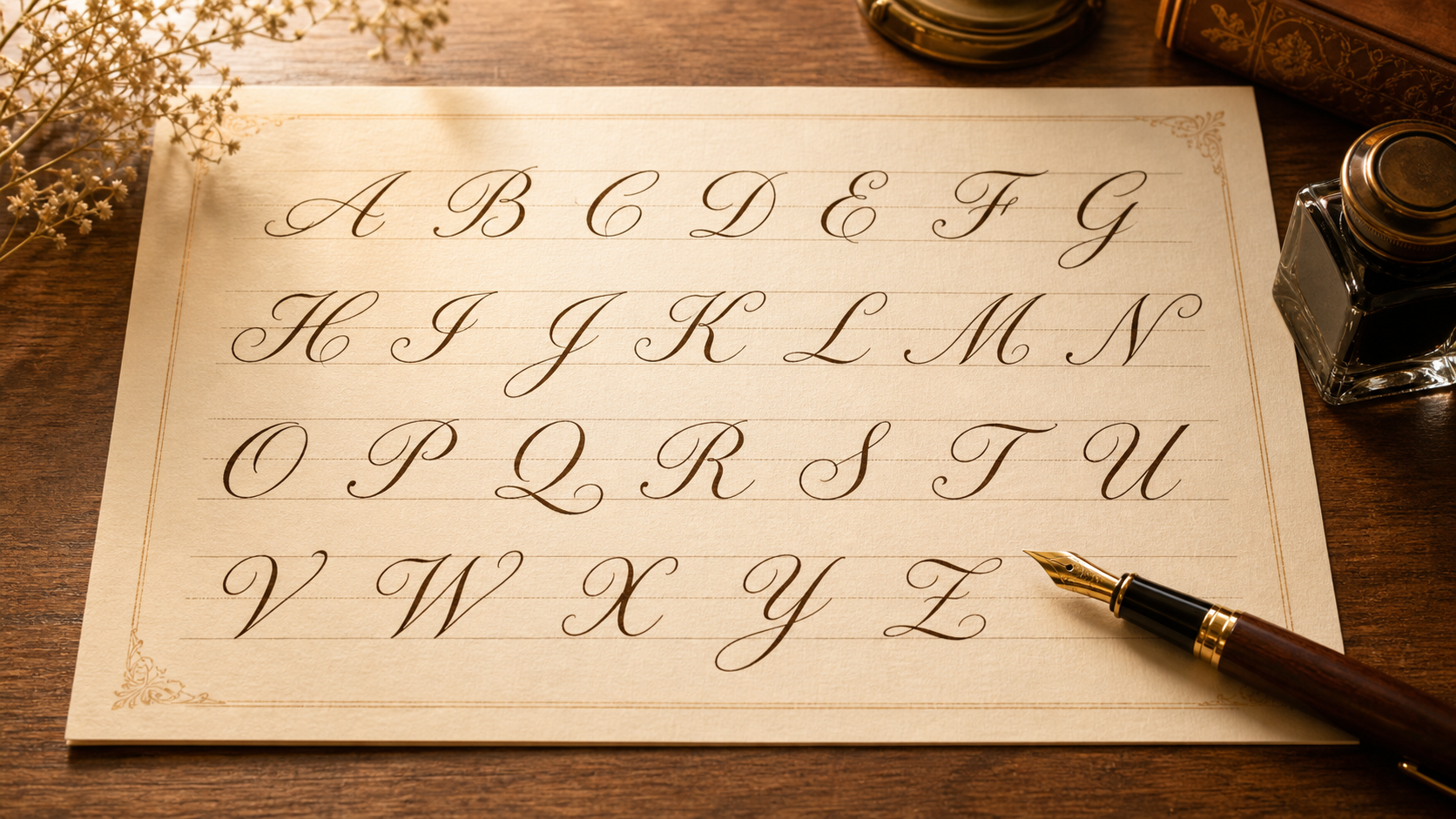
Cursive capital letters look nothing like their print counterparts — and that surprises most beginners. Uppercase cursive A might resemble a loopy figure-eight; F can look like a tall t with a crossbar; and Q famously resembles the number 2.
This guide explains why capitals are shaped differently, lists all 26 letters, and highlights the four that cause the most trouble.
What are cursive capital letters? (quick answer)
Cursive capital letters are the uppercase forms of the cursive alphabet: taller than lowercase, usually more decorative, and in most American styles they do not connect to the letter that follows. They keep the slant and rhythm of the rest of the word but stand alone on the line — which is why letters like Q, G, and Z change shape far more between print and cursive than any lowercase letter does. Start with the A-to-Z practice plan, or jump straight to a single letter's full guide in the A–Z quick-reference grid below.
Capital Cursive vs. Lowercase — Why They're So Different
Lowercase cursive letters are designed to connect — each letter exits on the baseline toward the next. Capital letters break that pattern:
- Capitals are larger and often start above the midline
- Most capitals do not connect to the following lowercase letter
- Capitals are more decorative — loops, flourishes, and tails are common
- You typically lift your pen after each capital before starting lowercase
Think of capitals as ceremonial entry points to words. They signal proper nouns, sentence starts, and emphasis — so their shapes prioritize recognition over speed.
How to write cursive capital letters A to Z
If your goal is how to write cursive capital letters A to Z, use this compact plan:
- Learn why capitals differ — they are taller, more decorative, and usually do not join the next lowercase letter.
- Practice in groups of five — loop starters (A, C, D, E, G, O, Q), tall ascenders (B, F, H, I, J, K, L, T), and the remaining forms so you are not jumping randomly across the alphabet.
- Isolate the hard four — Q, Z, G, and F deserve extra reps before you use them in names.
- Check a full chart — open the cursive alphabet generator for A–Z reference, then drill one letter on pages such as cursive Q or cursive I.
- Print practice — use the cursive worksheet generator with a capital letter or name so tracing and free writing sit on the same sheet.
The sections below expand each of those steps with charts, hard-letter notes, and FAQs—without changing the core A–Z practice order.

The 26 Capital Cursive Letters
Here is the standard American cursive uppercase alphabet. Practice in groups of five to avoid overwhelm:
| Group | Letters | Notes |
|---|---|---|
| Loop starters | A, C, D, E, G, O, Q | Begin with a counterclockwise oval or loop |
| Tall ascenders | B, F, H, I, J, K, L, T | Rise above the midline with a vertical stroke |
| Slanted forms | M, N, R, S, U, V, W, X, Y, Z | Diagonal or humped strokes dominate |
| Unique shapes | P | Descender drops below baseline |
To see how each letter is written in multiple script styles, open our free alphabet chart generator — it renders every uppercase and lowercase letter in real cursive fonts you can download.
Quick tips by group
Loop starters — Draw the oval first, then add tails or interior strokes without rushing.
Tall ascenders — Keep vertical strokes parallel; inconsistent slant makes words look messy.
Slanted forms — M and N use humps; Z uses a diagonal slash that trips up many writers.
Every capital letter has its own guide
Each letter below opens a full page with stroke animations, uppercase and lowercase steps, practice words, and a printable worksheet — the deep-dive versions of the tips on this page:
- Loop starters: cursive capital A · cursive capital C · cursive capital D · cursive capital E · cursive capital G · cursive capital O · cursive capital Q
- Tall ascenders: cursive capital B · cursive capital F · cursive capital H · cursive capital I · cursive capital J · cursive capital K · cursive capital L · cursive capital T
- Slanted forms: cursive capital M · cursive capital N · cursive capital R · cursive capital S · cursive capital U · cursive capital V · cursive capital W · cursive capital X · cursive capital Y · cursive capital Z
- Unique shape: cursive capital P — a bowl on a tall stem, grouped alone in the table above
Hardest Capital Letters (Q, Z, G, F)
These four letters account for most capital-letter questions. Focus extra practice here:

Q
The oval-plus-tail combination looks like 2. Start with the focused cursive Q uppercase and lowercase page, then read our full cursive Q guide for stroke-by-stroke instructions.
Z
Uppercase cursive Z often starts with a small loop at the top, then slashes diagonally down. It does not look like print Z at all — trace it slowly until the slash angle feels natural.
For Z-specific practice, use the cursive Z uppercase and lowercase page for animated tracing, font previews, and a printable worksheet.
G
Capital G combines a rounded body with a lower tail, so beginners often confuse it with C, O, or Q. Use the focused cursive G uppercase and lowercase page to compare the capital form, lowercase g descender, font previews, and printable G worksheet.
F
Capital F resembles a tall T with an extra crossbar. Beginners often forget the second crossbar or place it too low. The cursive F uppercase and lowercase page shows the loop, crossbar, and printable F worksheet together.
S
Capital S is easy to over-curve. If the upper loop opens too much, it can look like C; if the lower turn collapses, it may resemble a 5. The cursive S uppercase and lowercase page gives learners a single-letter practice path before they use S inside words.
J
Capital J drops below the baseline with a hook, while lowercase j needs both a tall stem and a descender. The cursive J uppercase and lowercase page is useful for names, initials, and capital-letter practice because it isolates that baseline hook.
K
Capital K combines a tall stem with two angled strokes, so rushed loops can look like R or H. The cursive K uppercase and lowercase page is the best place to practice those diagonals before using K inside words like Kind and King.
T
Capital T in cursive needs a confident stem and a light crossbar placed high enough to stay readable. The cursive T uppercase and lowercase page helps learners master the crossbar timing that separates T from F or L.
E
Capital E often starts with a loop like C or L, while lowercase e must close cleanly in connected writing. The cursive E uppercase and lowercase page gives students a focused tracing path before they return to the full alphabet chart.
D
Capital D belongs to the loop-starter family with C and O, while lowercase d is a tall letter with a round bowl that can look like cl when rushed. The cursive D uppercase and lowercase page helps learners master the oval body, tall stem, and printable Dd worksheet.
B
Capital B stacks two rounded bowls on a vertical stem, so tight loops can resemble P, R, or 8. The cursive B uppercase and lowercase page is the best place to practice those double bowls before using B inside words like Beauty and Brave.
I
Capital I is a tall stem, but lowercase i depends on dot placement — forget the dot and it looks like l. The cursive I uppercase and lowercase page isolates stem height and dot timing for names, initials, and classroom tracing.
Practice these hard capitals in isolation before using them in words. The cursive letter generator lets you preview any single capital letter across multiple fonts.
Practice Sheet (Free Alphabet Chart)
The best capital-letter practice combines tracing with visual reference:
Free Cursive Alphabet Chart Generator
View and download all 26 uppercase and lowercase cursive letters in multiple script fonts. Perfect for desk reference and classroom use.
Open free tool →For printable trace sheets, use the cursive worksheet generator — enter any capital letter or word and download a practice PDF.
Children learning their name benefit from the cursive name generator, which previews first-name capitals in elegant script styles.
Connecting Capitals to Lowercase Words
When you write a sentence, the pattern is:
- Write the capital (pen lifts)
- Start the first lowercase letter on the baseline
- Connect remaining lowercase letters normally
Example: Hello — capital H, lift, connect ello without lifting.
Type sample sentences in the cursive writing generator to see how capitals and lowercase flow together in longer text.
Frequently Asked Questions
Do all cursive capitals connect to lowercase letters?
No. Most capitals stand alone. Only a few informal styles attempt capital-to-lowercase joins, but standard school cursive treats capitals as separate strokes.
What is the easiest capital letter to start with?
C and O are good starters — both use a simple counterclockwise oval.
How are cursive capitals different from calligraphy capitals?
Calligraphy capitals often include elaborate flourishes and thick-thin stroke variation. School cursive capitals are simpler and optimized for writing speed. For formal calligraphy capitals, try our cursive calligraphy generator.
Can I download a printable capital letters chart?
Yes. The cursive alphabet generator produces downloadable PNG and SVG charts with all capitals.
Which capitals should I practice last?
Save Q, Z, G, and F for after you are comfortable with simpler loop and ascender letters.
Which cursive capitals look like numbers?
The traditional cursive Q is the famous one — its rounded body and long sweeping tail read like a decorative 2. A few other capitals surprise people on first sight (the zigzag Z, the open-bowled G), but Q is the only capital routinely mistaken for a numeral, which is why the cursive Q letter guide spends a full section on it.
What is the hardest cursive capital letter?
For most learners it is Q, followed by G and Z — all three replace the familiar print shape with an unfamiliar loop or tail. The hardest capitals section above breaks down each one; if one letter is holding you back, its single-letter guide in the A–Z grid has focused stroke demos and a worksheet.
Related Guides
-
Cursive F Letter Guide - animated stroke order and printable F worksheet
-
Cursive Z Letter Guide - looped Z shape, font previews, and tracing practice
-
Cursive Q Letter Guide - Q-only quick reference with printable worksheet
-
Cursive K Letter Guide - angled capital K strokes and printable Kk worksheet
-
Cursive T Letter Guide - capital T crossbar practice and lowercase t tracing
-
Cursive E Letter Guide - looped capital E and lowercase e closure drills
-
Cursive D Letter Guide - loop-starter capital D and tall lowercase d tracing
-
Cursive B Letter Guide - double-bowl capital B and printable Bb worksheet
-
Cursive I Letter Guide - tall capital I stem and lowercase i dot placement
-
How to Write in Cursive — full beginner tutorial with basic strokes
-
How to Write Cursive Q — deep dive on the trickiest capital
-
Cursive Name Generator — practice your capital initial in script
Want to try these styles on your own text? The cursive generator previews any word across every font on the site and exports a transparent PNG or SVG.