D'Nealian vs Zaner-Bloser - Which Cursive Style Wins?
Compare D'Nealian vs Zaner-Bloser cursive letterforms, teaching goals, and worksheets. Choose the best handwriting style for your child or US classroom.
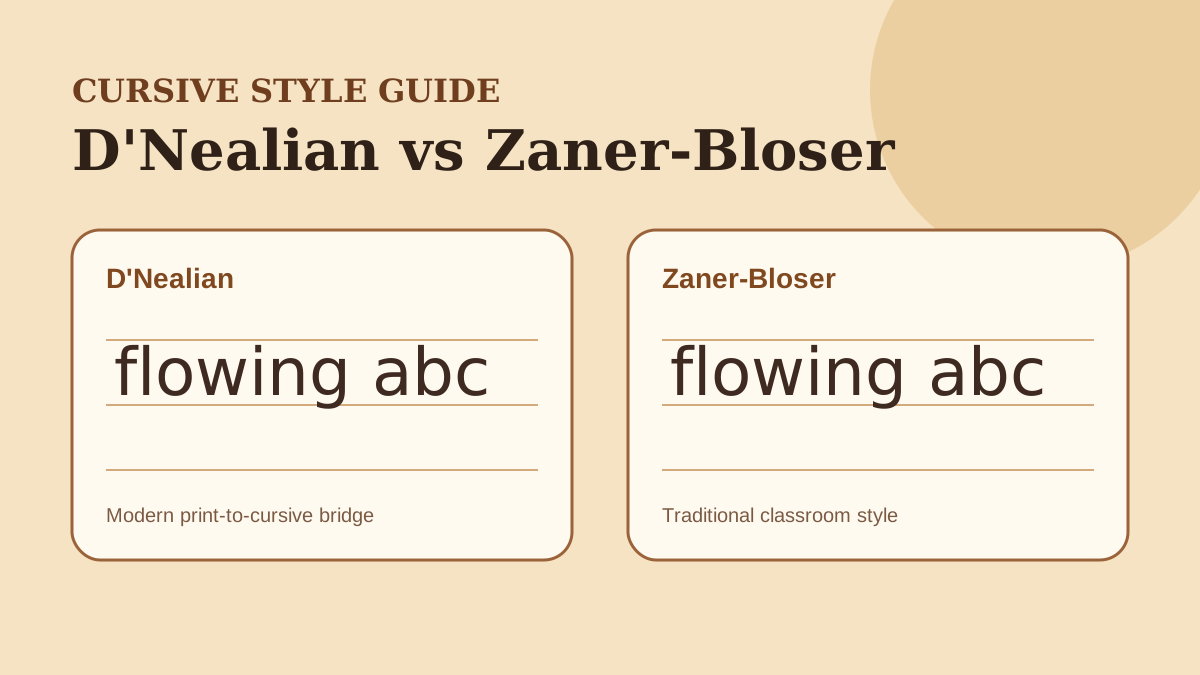
If you are choosing a handwriting curriculum, D'Nealian vs Zaner-Bloser is the comparison you will see most often. Both teach readable American cursive. The practical difference is how children reach that goal: Zaner-Bloser separates manuscript and cursive more clearly, while D'Nealian starts with a slanted manuscript designed to ease the transition.
The Two Dominant US Cursive Curricula
Neither style is universally "correct." Schools, homeschool families, and adult learners use both. Your best choice depends on the print style a learner already knows, the materials available, and whether consistency or an easy transition matters most.
| Question | Zaner-Bloser | D'Nealian |
|---|---|---|
| Starting point | Upright manuscript | Slanted manuscript with tails |
| Cursive look | Traditional loops and joins | Simplified, modern joins |
| Transition from print | More distinct change | Designed as a bridge |
| Best fit | Traditional classroom sequence | Learners already using D'Nealian print |
Zaner-Bloser: The Traditional Style (1900s)
Zaner-Bloser grew from the penmanship tradition associated with Charles Paxton Zaner and Elmer Ward Bloser. Its school handwriting program uses a familiar sequence: learn clear manuscript first, then learn a more visibly distinct cursive alphabet.
The style is recognizable for rounded forms, traditional loops, and letter shapes many adults remember from elementary school. That familiarity is useful when a parent or teacher wants to model letters by hand.
Use Zaner-Bloser when:
- The learner already writes upright manuscript comfortably.
- You want a traditional US school-cursive appearance.
- Existing classroom workbooks use Zaner-Bloser models.
D'Nealian: The Modern Style (1978)
Donald Thurber introduced D'Nealian handwriting in 1978. Its manuscript letters tilt slightly forward and often include exit strokes. The idea is simple: if printed letters already lean and prepare for joins, the jump to cursive may feel smaller.
D'Nealian cursive usually looks less ornamental than older school scripts. Some learners appreciate that continuity. Others find the slanted manuscript harder to read at first, so it is worth previewing both approaches before switching a child who already has an established print style.
Use D'Nealian when:
- The learner is starting with D'Nealian manuscript.
- You want a print-to-cursive bridge with fewer dramatic shape changes.
- Your school materials already use slanted manuscript models.
Side-by-Side Letter Comparison
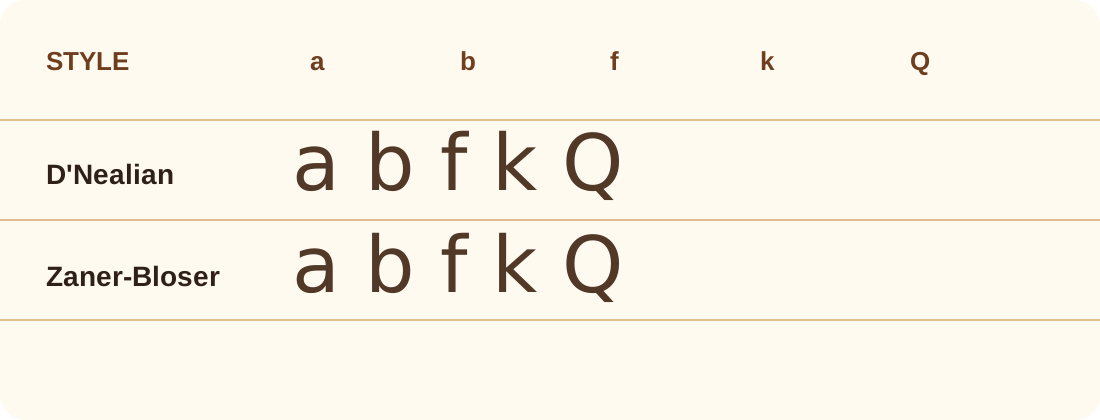
The biggest differences appear in letters with loops, unusual capitals, or strong entry strokes.
| Letter | Zaner-Bloser tendency | D'Nealian tendency |
|---|---|---|
lowercase a | Rounded oval with traditional exit | Similar oval with a simpler transition |
lowercase b | Tall loop and clear connector | Streamlined loop and exit |
lowercase f | Traditional looped descender | Simpler continuous stroke |
lowercase k | More formal loop-and-arm shape | Reduced, print-adjacent shape |
uppercase Q | Traditional school-script form | Simplified modern form |
Preview more forms with the cursive alphabet generator, then compare the same word using the cursive writing generator.
Which Should You Teach Your Child?
Choose the style the learner sees most often at school. Mixing models can slow practice because small differences feel like mistakes when children are still building muscle memory.
For homeschool use, choose one alphabet chart and use it consistently for several weeks. Zaner-Bloser is a sensible default for a traditional result. D'Nealian is a good choice when the learner already uses D'Nealian manuscript or benefits from a gentler visual transition.
For extra context, see our free cursive alphabet chart and beginner cursive guide.
Free Worksheets in Both Styles
The most useful test is a page of actual practice. Generate a worksheet for the child's name, a short sentence, or one difficult letter. Print both style options and keep the one that feels more natural.
Create a Free Cursive Worksheet
Type a name, word, or sentence and generate printable cursive practice lines. Compare styles before choosing a curriculum.
Open free tool →Frequently Asked Questions
Is D'Nealian the same as cursive?
D'Nealian is a handwriting curriculum with both manuscript and cursive forms. Its manuscript style is slanted and designed to prepare learners for connected writing.
Is Zaner-Bloser still taught?
Yes. Zaner-Bloser remains a widely recognized US handwriting program and continues to publish classroom materials.
Can a child switch between D'Nealian and Zaner-Bloser?
Yes, but early learners usually benefit from one consistent model. Switch deliberately rather than mixing letterforms on the same worksheet.
Which style is easier?
There is no universal winner. D'Nealian can make the print-to-cursive transition feel smaller; Zaner-Bloser can be easier to support when adults and classroom materials already use its traditional forms.
Where can I print practice sheets?
Use the cursive worksheet generator for words and names, or the cursive alphabet generator for an A-Z reference.
Every style shown in this guide is also available in our cursive generator, alongside the copy-paste output and image downloads.